Thursday, November 10, 2011

Conclusion.


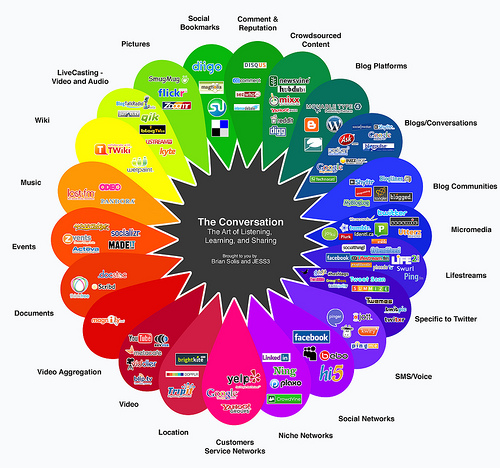
(source: http://compassioninpolitics.wordpress.com/2008/11/16/five-top-social-media-and-web-trends-for-2009/, 2008)

Throughout this blogging experience, I have learned so much on various types of issues and trends happening within the current media. I have learn that the new media refers to the wide range of changes happening in media productions, distribution and use. The media is constantly evolving using various ways to improve itself for us, who uses media inevitably in one way or another, no matter how old or young we are.


(source:http://www.samsung.com/us/article/14-social-media-trends-to-watch, n.d)
Wednesday, November 9, 2011

Item 4-d

8. Discussion concepts: semiotic landscape (valuation of modes), genre change & audience expectations & iPad usability/ web design; multimodality.

iPad-only newspaper furthers media trend.

This article written by Trotter (2011), talks about the growing trend of newspaper on print screen versus the traditional newspaper. Ever since Rupert Murdoch's new iPad-only newspaper on 2 February indicates the transition of news from the traditional paper newspaper to the internet form newspaper. Here is a video from Youtube showing the newspaper format on the iPad. 


Now, even though the features of a newspaper on iPad is more advanced and interactive but some readers still prefer the old traditional newspaper or even just reading newspaper from the desktop. This could be due to genre change and audience's expectation. 

According to Corner (cited in Chandler 1997, p. 8), genre is the key factor in the influence of audience's choice and of audience expectations towards what is appropriate for watching, listening to and reading different types of thing. In this case, younger generations may favor the concept of iPad-only newspaper because of its cool features but others may prefer the old traditional newspaper because they like the texture of the newspaper and the sound of it as pages flip. 

Manchel (1990, p. 684) states that no matter how genre changes from one form to another, it all still depends on the audience's expectations and needs. Hence why even though the iPad-only newspaper has more functions, some audiences still prefer old style newspaper. Trotter concluded the article by stating that  there is no certainty that old style newspaper will come to an end due to its demands, the only thing certain is the continuous decline of newspaper circulations as news consumptions transitions online. 

In my opinion, genre change is largely affected by audience's expectations. No matter how advance or user-friendly the iPad-only newspaper is, there is still a strong demand for the traditional paper, which is why the circulation of newspaper continues. Audiences still expect to see more, feel the texture and hear the sounds made by old-style newspapers. 

References: 
  1. Trotter, C 2011, 'iPad-only newspaper furthers media trend', Cento, 17 February, viewed 9 November 2011, <http://www.thecento.com/news/2011/feb/17/ipad-only-newspaper-furthers-media-trend/>.
  2. PageSuite 2010, Daily and Sunday Express live iPad demo, video, Youtube, April 14, viewed 9 November 2011, <http://www.youtube.com/watch?feature=player_embedded&v=x3ff4LJzRzg>.
  3. Chandler, D 1997, An introduction to genre theory, viewed 9 November 2011, <http://www.aber.ac.uk/~mcswww/Documents/intgenre/chandler_genre_theory.pdf>.
  4. Manchel, F 1990, Film Study: An analytical bibliography, Fairleigh Dickinson Univ Press, United States of America. 

Tuesday, November 8, 2011

Item 4-c

7. Discussion concepts: situational/ cultural context; advertising ethics; contestation of ideology

Media Prima pulls out ‘racist’ Ramadan ads

Chieh (2011) from the Malaysian Insider has reported that Media Prima have decided to axe a controversial series of Ramadan advertisement on 8tv channel, which caused an outraged among citizens condemning the commercial to be racist in nature. 8tv was later fined Rm 50,000 by Malaysia Communications and Multimedia Commissions (MCMC). Here is a Youtube video by 154thMedia (2011) reporting on this particular issue. 


The Advertising Standard Authorities (ASA) was created in 1977 to provide independent scrutiny on self-regulatory system done by the industry. ASA constitute members consist of Malaysian Advertisers Association, Association of Accredited Advertising Agents, Malaysia, Malaysian Newspaper Publishers Association and Media Specialists Association. Advertisements that are depicted as offensive in any way is detriment by ASA immediately. 


According to the Asian Market Research News (2002), the Malaysian Advertising Code has strong control exerted by Malaysian Ministry of Information, the main important key of Malaysian policy in ensuring that information are closely watched and controlled to prevent anything that might harm the government's own social engineering. 


In this case, the Ramadan advertisement has violated one of Malaysian Code of Advertising Practice. According to ASA (n.d.), advertisement must not typecast each particular racial group with vocation, traditional values and background. The Chinese girl in this advertisement is stereotyped as rude, loud and indecent among the community. 


Images in advertising that includes nudity, anti-social behavior, racist and sexist images are strictly prohibited in the Malaysian advertising to reduce the degree of offense in the community (Waller n.d, p. 5). It is no wonder why this advertisement was immediately pulled out after it received a public outcry from Malaysian citizens.


References: 

  1. Chieh, YH 2011, 'Media Prima pulls out 'racist' Ramadan ads', Malaysian Insider, 2 August, viewed 9 November 2011, <http://www.themalaysianinsider.com/print/malaysia/media-prima-pulls-out-racist-ramadan-ads/>.
  2. 154thMedia 2011, News: Malaysian TV station Ramadan Ads sparks debate, video, Youtube, 3 August, viewed 9 November 2011, <http://www.youtube.com/watch?v=ke7p5rp-nbI>.
  3. The Code of Advertising Practice n.d, Advertising Standards Authority, Malaysia, viewed 9 November 2011, <http://www.asa.org.my/thecode.htm>.
  4. The Malaysian Advertising Code of ethics for TV and radio, Asian Market Research News, Malaysia, viewed 9 November 2011, <http://www.asiamarketresearch.com/news/000158.htm>.
  5. Waller, DS n.d, Cultural values and advertising in Malaysia: Views from the industry, Asia Pacific Journal of Marketing and Logistics, University of Newcastle, viewed 9 November 2011, <http://www.google.com.my/url?sa=t&rct=j&q=advertising%20ethics%20in%20malaysia&source=web&cd=4&ved=0CDoQFjAD&url=http%3A%2F%2Fciteseerx.ist.psu.edu%2Fviewdoc%2Fdownload%3Fdoi%3D10.1.1.202.3457%26rep%3Drep1%26type%3Dpdf&ei=-uG5TrpPhvGtB-_a0bMG&usg=AFQjCNEpITdWxX-j4nr_DyJ-mK21mVLTOA&cad=rja>.

Monday, November 7, 2011

Item 4-b

6. Discussion concepts: multimedia news & multimodality; business of the media & depth, interactivity, immediacy; produsage; screen/ web genres & audiences' preferences/ expectations


This article written by O'Neill (2011) discusses the current trend on media websites to cover news. Below shows a video blog done by Douglas Simon on the results of an online survey delivered to over a huge number of media influencers, roughly around 1,000 of them on the field of TV, radio, newspaper, and web media properties. Watch the video below to see the results on this survey. 


As you can see, there is a 33% increase on media outlets that are using online video to cover news as compared to last year's survey. The growth of this trend seems to show to sign on stopping anytime soon. 


This is an example of video news featured on the Voice of America taken from my desktop. Did you know that video news is a form of multimodality? According Walsh (2006, p. 24), video is a form of multimodal text in non-print form. So what is multimodality? Walsh described it as a multimodal text that consist of more than one 'mode', so that meaning is being conveyed through a synchronization of modes. Therefore they may incorporate written or spoken language, still or moving pictures, produced on paper or electronic screen that may include music and sound. In this case, news is combined with online video, which makes it a multimodal text in non-print form. 


This form of news is also known as multimedia journalism, Dueze (2004, p.140) states that there are two of defining multimedia in  news: 

  1. As presentation of news story package on a website using two or more media formats that includes interactive and hypertextual elements. 
  2. Presentation of news story through various types of media such as website, email, newspaper, magazine and many more. 
The idea of both multimodal text and multimedia news is so huge that even Times is using it as tool to keep readers tuned in to their latest news. According to Zhang (2011) in an interview with Amy Harmon, the Pulitzer Prize winning National correspondent for the New York Times, Harmon states that the use of multimedia journalism is to keep readers listening, watching and looking for news.


Photobucket

This is an example of the use of multimedia news on The New York Times taken directly from my desktop. Because of how user-friendly and interactive multimodals are, I understand why it is becoming such a fast, strong growing trend among generations these days.


References: 
  1. Walsh, M 2006, 'The 'textual shift': Examining the reading process with print, visual and multimodal texts', Australian Journal of Language and Literacy, vol. 29, no. 1, pp 24-37.
  2. Dueze, M 2004, 'What is multimedia journalism?', Journalism Studies, vol. 5, no. 2, viewed 9 November 2011, <http://indiana.academia.edu/MarkDeuze/Papers/725187/What_is_Multimedia_Journalism>.
  3. Zhang, M 2011, 'Multimedia in journalism: An interview with the Times' Amy Harmon', Mediabistro, 3 November, viewed 9 November 2011, <http://www.mediabistro.com/10000words/multimedia-journalism-interview-amy-harmon-quick-link_b8143>.
  4. O'Neill, M 2011, '85% of media websites now use online video to cover news', Social Times, 3 May, viewed 9 November 2011, <http://socialtimes.com/85-of-media-websites-now-use-online-video-to-cover-news_b60505>.

Item 4-a

Discussion concepts: Visuals & situational/ cultural context; ethical publishing principles; photojournalism ethics.


Orthodox Jewish paper apologises for Hillary Clinton deletion


According to Associated Press (2011), Orthodox Jewish paper apologizes for Hillary Clinton, the U.S secretary of state and Audrey Tomason, the counterterrorism director deletion in New York paper Di Tzeitung which sparked an outraged among American citizens. 


(source:http://www.guardian.co.uk/world/2011/may/10/jewish-paper-apologises-hillary-clinton)


Above shows the published picture and the original picture below it. According to Di Tzeitung, they had explained that the deletion of Hillary Clinton and Audrey Tomason was due to their "long standing editorial policy" of not publishing women's images. It is said that their readers believe that women should be appreciated for who and what they are but not what they look. The Jewish law of modesty is an expression of respect for women and not other wise. However, most the Orthodox Jewish communities disagreed, they appreciated Hillary Clinton's unique capabilities, talents and compassion for all, which lead to the acknowledgement of Di Tzeitung that they should not have published the altered picture. 


Di Tzeitung is known as a very religious paper. Ravitz (2011) reported that in a written statement by Di Tzeitung, publishing a newspaper is a heavy responsibilities and their policies are guided by Rabbinical Board and due to their modesty laws, they were not allowed to published images of women. Others such as  Robin Bodner, the executive director of Jewish Orthodox Feminist Alliance found this very offensive while a former ultra-Orthodox Jew, Rosenberg called this 'strange media' with their strange censorship on women. 


According to Schriver (1997, p. 14) research in cross-cultural document designs agree that graphics are not necessary obvious and the order in people read matters. Hence, why Di Tzeitung followed their editorial policy on not publishing women's images. This is because readers matter. Secondly, no one would understand the reason of the absence of women in this newspaper except for the Jewish communities itself. This is known as semiotic landscape. Kress and Van Leeuwen (2006, p. 35) states that semiotic landscape is the construction of signs and symbols that can only be understood within or across culture. In this case, the deletion of Hillary Clinton, to many it may be offensive but according to the Jewish Law, for their culture, it is a sign of respect for women in general. 

From this article, I understand that different cultures have different rules and regulation when it came to press content. Di Tzeitung was simply following their long term policy and I believe they should not be wronged for their actions. It is simply due to the difference of culture. We should take time to study and understand their culture before judging their actions. Nevertheless, Di Tzeitung apologized for their actions and regretted publishing the altered picture. 


References:
  1. Schriver, KA 1997, Dynamics in document design: Creating texts for readers, Wiley Computer Pub, New York. 
  2. Kress, GR & van Leeuwen, T 2006, Reading images: The grammar of visual design, Routledge, New York.
  3. Ravitz, J 2011, 'Religious paper apologizes for erasing Clinton from iconic photo', CNN, 9 May, viewed 7 November 2011, <http://religion.blogs.cnn.com/2011/05/09/religious-paper-cuts-clinton-from-iconic-photo/>.
  4. Associated Press 2011, 'Orthodox Jewish paper apologizes for Hillary Clinton deletion', Guardian, 10 May, viewed 7 November 2011, <http://www.guardian.co.uk/world/2011/may/10/jewish-paper-apologises-hillary-clinton>.